
September 8, 2006 Issue
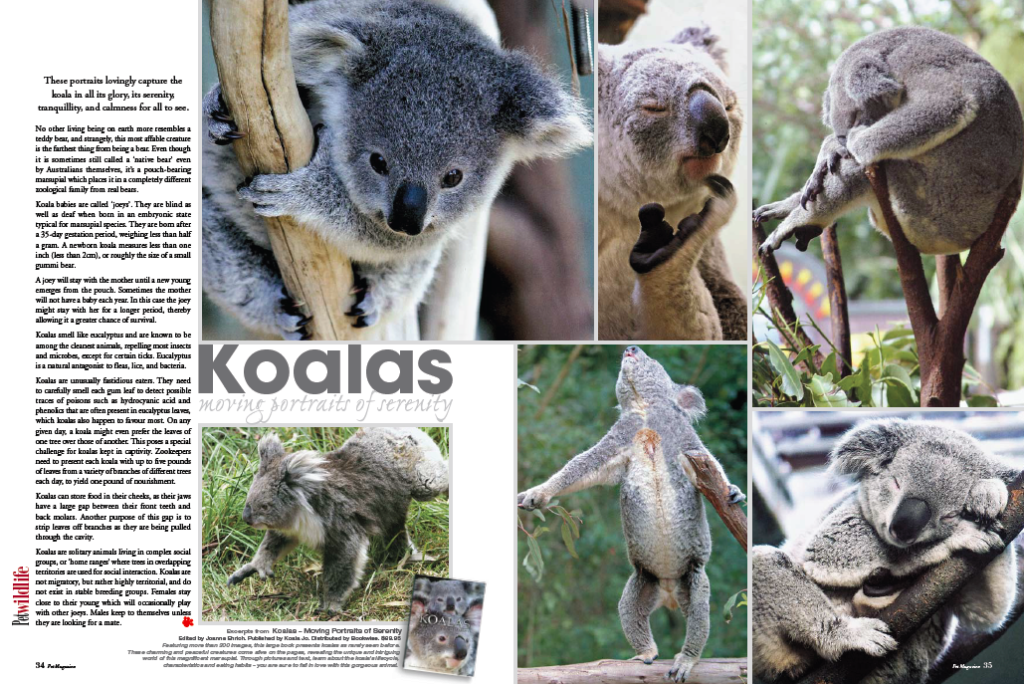
These portraits lovingly capture the
koala in all its glory, its serenity,
tranquillity, and calmness for all to see.
No other living being on earth more resembles a
teddy bear, and strangely, this most affable creature
is the farthest thing from being a bear. Even though
it is sometimes still called a ‘native bear’ even
by Australians themselves, it’s a pouch-bearing
marsupial which places it in a completely different
zoological family from real bears.
Koala babies are called ‘joeys’. They are blind as
well as deaf when born in an embryonic state
typical for marsupial species. They are born after
a 35-day gestation period, weighing less than half
a gram. A newborn koala measures less than one
inch (less than 2cm), or roughly the size of a small
gummi bear.
A joey will stay with the mother until a new young
emerges from the pouch. Sometimes the mother
will not have a baby each year. In this case the joey
might stay with her for a longer period, thereby
allowing it a greater chance of survival.
Koalas smell like eucalyptus and are known to be
among the cleanest animals, repelling most insects
and microbes, except for certain ticks. Eucalyptus
is a natural antagonist to fleas, lice, and bacteria.
Koalas are unusually fastidious eaters. They need
to carefully smell each gum leaf to detect possible
traces of poisons such as hydrocyanic acid and
phenolics that are often present in eucalyptus leaves,
which koalas also happen to favour most. On any
given day, a koala might even prefer the leaves of
one tree over those of another. This poses a special
challenge for koalas kept in captivity. Zookeepers
need to present each koala with up to five pounds
of leaves from a variety of branches of different trees
each day, to yield one pound of nourishment.
Koalas can store food in their cheeks, as their jaws
have a large gap between their front teeth and
back molars. Another purpose of this gap is to
strip leaves off branches as they are being pulled
through the cavity.
Koalas are solitary animals living in complex social
groups, or ‘home ranges’ where trees in overlapping
territories are used for social interaction. Koalas are
not migratory, but rather highly territorial, and do
not exist in stable breeding groups. Females stay
close to their young which will occasionally play
with other joeys. Males keep to themselves unless
they are looking for a mate.
Excerpts from Koalas – Moving Portraits of Serenity
by Joanne Ehrich. Published by Koala Jo. Distributed by Bookwise. $69.95
Featuring more than 300 images, this large book presents koalas as rarely seen before.
These charming and peaceful creatures come alive on the pages, revealing the unique and intriguing
world of this magnificent marsupial. Through pictures and text, learn about the koala’s lifecycle,
characteristics and eating habits – you are sure to fall in love with this gorgeous animal.